Sleep medicine guide
Home Sleep Tests vs In-Lab Polysomnography
AHIguide Editorial Team · 9 min read · Updated May 12, 2026
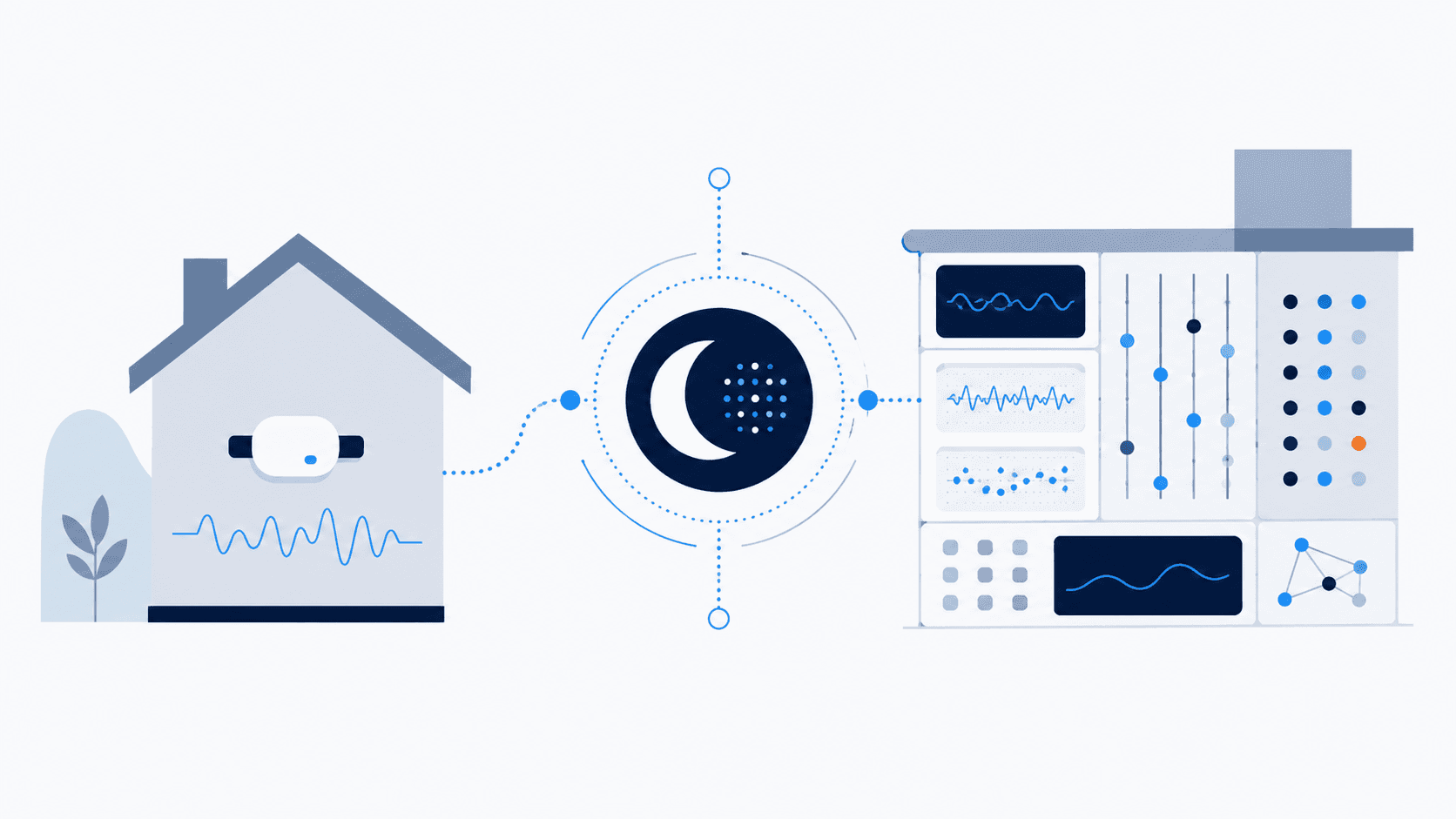
Sleep testing used to mean a single thing: an overnight stay at a sleep lab, hooked to dozens of electrodes, monitored by a technician through the night. That is still the diagnostic gold standard, but it is no longer the only option. Most insurance plans now cover home sleep apnea tests for patients with suspected obstructive sleep apnea, and a meaningful fraction of cases never need in-lab evaluation at all.
Which test is right for you depends on what your physician is trying to find out, what comorbidities you have, and what your insurance is willing to pay for. This guide walks through what each test measures, when each is appropriate per AASM guidelines, what HSAT can and cannot detect, and what to do when an HSAT result is ambiguous in a patient who clearly has symptoms.
What in-lab polysomnography measures
In-lab PSG records a comprehensive set of signals overnight. A typical setup includes:
- EEG (electroencephalogram) electrodes on the scalp to score sleep versus wake, sleep stage (N1, N2, N3, REM), and arousals
- Electrodes near the eyes to track eye movements (which help distinguish REM sleep from other stages)
- Chin muscle electrodes to track muscle tone, which drops during REM
- Effort belts on the chest and abdomen to measure breathing effort and distinguish obstructive from central events
- Nasal airflow via a thermistor or pressure transducer near the nostrils
- Pulse oximetry on a finger to track oxygen saturation continuously
- ECG (electrocardiogram) for heart rhythm
- Leg electrodes to detect periodic limb movements
A technician monitors the recording through the night and can intervene if a sensor needs adjustment. The next morning, a registered polysomnographic technologist scores the recording: identifying sleep stages, marking apneas and hypopneas and RERAs, counting arousals and leg movements, and calculating the indices that end up on your report.
The combination of signals is what makes PSG the diagnostic gold standard. It can answer not just "did you have apnea events?" but also "how was your sleep architecture?" and "did you have central apnea?" and "do you have a separate condition (restless legs syndrome, periodic limb movement disorder, parasomnia) that needs its own workup?"
What home sleep apnea testing measures
HSAT uses a simpler device that you take home, set up yourself, sleep with for one or several nights, and return. The most common HSAT devices measure:
- Airflow (typically via a nasal pressure cannula)
- Respiratory effort (typically via a chest belt)
- Oxygen saturation (via finger pulse oximeter)
- Sometimes: heart rate, body position, snoring detection
What HSAT does not measure: EEG, eye movements, chin muscle tone, leg muscle activity, sleep architecture, sleep stages, or arousals. The absence of EEG is the single biggest limitation, because it means HSAT cannot directly score sleep versus wake.
A newer category of HSAT devices uses peripheral arterial tonometry (PAT), which measures small changes in blood flow at the fingertip that correlate with autonomic arousal. PAT-based HSAT estimates sleep stages and arousals indirectly. It is more capable than traditional HSAT and approaches PSG sensitivity in some validation studies, but it is still considered limited evidence for complex cases.
When AASM recommends HSAT
The 2017 AASM clinical practice guideline says HSAT is appropriate for patients who have:
- A moderate to high pre-test probability of moderate to severe OSA
- No significant cardiopulmonary disease
- No neuromuscular disease
- No suspected central sleep apnea
- No chronic opioid use
- No suspected hypoventilation syndromes
- No other suspected sleep disorders that would require a full PSG
The guideline explicitly does not recommend HSAT for patients with the conditions in the contraindication list above. PSG is required for those cases.
For uncomplicated suspected OSA, HSAT is now the default initial test in most insurance plans. PSG is reserved for complex cases, for HSAT follow-up when results are equivocal, or for cases where the patient cannot tolerate or properly set up the HSAT device at home.
What HSAT can miss
Several limitations of HSAT matter clinically.
HSAT under-reports the AHI. Because it cannot directly measure sleep versus wake, HSAT uses total recording time as the denominator (which is what makes the index REI instead of AHI). If you spent two hours of an eight-hour recording awake but quiet, those two hours are still in the denominator. Your REI of 12 might correspond to an AHI of 16 on PSG. AASM acknowledges this. The typical interpretation is to consider HSAT-derived numbers as likely lower than the true PSG-equivalent AHI. For the broader picture of how AHI, RDI, ODI, and REI compare, see AHI vs RDI vs ODI: Sleep Study Metrics Explained.
HSAT cannot reliably detect central apnea. Central apneas, where breathing effort itself stops rather than airflow being blocked despite continued effort, require effort belt data plus EEG context for confident scoring. HSAT effort belts can detect some central events, but the absence of EEG means many are missed or misclassified. If your physician suspects central apnea (in heart failure, after stroke, on chronic opioids, or related to high altitude), PSG is required.
HSAT cannot assess sleep architecture. Time fractions in N1, N2, N3, and REM; arousal density; sleep efficiency; sleep latency: none of these are directly measured. A patient with severe sleep fragmentation but only modest AHI cannot have that fragmentation quantified by HSAT.
HSAT misses periodic limb movements. No leg muscle electrodes. If your physician suspects PLMD or restless legs as a co-condition (or as an alternative explanation for fatigue), HSAT will not address it.
HSAT single-night results are noisier than averaged data. Inter-night variability in breathing event frequency is real. Typical patients can vary their measured AHI by 30 to 50% between any two nights, driven by alcohol, position, nasal congestion, sleep deprivation, and other factors. PSG samples one night; single-night HSAT also samples one night. The newer multi-night HSAT devices address this by averaging across 3 to 7 nights, which improves diagnostic confidence substantially.
The negative HSAT problem
A negative HSAT in a symptomatic patient is the most clinically important scenario for understanding HSAT's limits. If your physician strongly suspects OSA based on symptoms (loud snoring, witnessed apneas, daytime sleepiness, hypertension that is hard to control) and your HSAT result is normal or borderline, the answer is not necessarily "you do not have sleep apnea." It is "your HSAT result was negative on a less sensitive test."
In this scenario, AASM recommends in-lab PSG as the next step. The combination of HSAT's structural under-reporting and the night-to-night variability of breathing events means that single negative HSATs are reliable only when pre-test probability is low to moderate. For high pre-test probability patients, a negative HSAT should be followed by PSG, not by reassurance.
This is also where multi-night HSAT can serve as an intermediate step. A 3-night or 7-night HSAT improves sensitivity over a single-night test and may catch cases that a single-night HSAT would miss. If your single-night HSAT was negative and your physician is on the fence about a PSG referral, a multi-night HSAT can be a sensible middle path.
Practical considerations: cost, convenience, insurance
HSAT is cheaper than PSG. Out-of-pocket costs for HSAT typically run a few hundred dollars; PSG runs $1,000 to $3,000 or more depending on facility and insurance. Most insurance plans cover HSAT for appropriate indications without prior authorization. PSG often requires prior authorization or documented evidence of HSAT failure.
HSAT is more convenient. You sleep in your own bed, on your own schedule, with no commute and no stranger nearby. Setup is straightforward (the device comes with instructions, and some providers offer a video setup call with a sleep technician). Many patients find this experience much less intimidating than an in-lab study, which lowers the barrier to actually getting tested at all.
PSG is more comprehensive. If you have multiple potential sleep disorders, complex medical history, or a previous HSAT that was equivocal, PSG produces an answer that HSAT cannot. The trade-off is one night in an unfamiliar bed with wires attached, plus higher cost and more insurance friction.
What to do with this
When your physician orders a sleep test, ask which one they have in mind and why. For straightforward suspected OSA in an otherwise healthy adult, HSAT is reasonable. If you have heart failure, recent stroke, chronic opioid use, or significant pulmonary disease, ask whether PSG is more appropriate per AASM guidelines.
If you get an HSAT and the result is negative but you still have symptoms, do not let the negative result close the case. Ask about either a multi-night HSAT or an in-lab PSG follow-up. A negative HSAT in a symptomatic patient is not a clean answer. It is a less sensitive test returning a less reliable negative.
If you have your sleep study results in hand and want to understand the AHI severity tier they fall into and what AASM considers first-line treatment at that tier, you can use the AHI Interpreter.
The right test is the one that answers the question your physician needs to answer. For most uncomplicated cases, that is HSAT. For everything else, it is PSG. And for the in-between cases (symptomatic patient, negative single-night HSAT), the answer is usually a more careful follow-up, not a different conclusion from the same test.
Sources
This article is grounded in the primary clinical sources below, linked so you can verify the details yourself.
- Kapur et al. Clinical Practice Guideline for Diagnostic Testing for Adult OSA, AASM 2017
Source for when a home sleep apnea test is appropriate, which conditions require in-lab polysomnography, and the recommendation to follow a negative or technically inadequate home test with PSG.
- AASM Manual for the Scoring of Sleep and Associated Events (Version 3, 2023)
Source for how respiratory events are scored and why a home test uses recording time (REI) rather than sleep time.
Related
AHI Interpreter
Enter your AHI to see severity tier, what it means, and treatment landscape.
Understanding Your Sleep Study Report
What every number on your sleep study report actually means, including the sections most patients miss.
AHI vs RDI vs ODI: Sleep Study Metrics Explained
The three numbers most people see on their sleep study results: what each one measures, why they can disagree, and which one drives diagnosis.
Educational only, not medical advice. Information provided is for educational purposes and is not a substitute for professional medical advice, diagnosis, or treatment. Talk to your physician about your sleep test results.
First published: May 12, 2026 · Last modified: May 12, 2026