Sleep medicine guide
AHI vs RDI vs ODI: Sleep Study Metrics Explained
AHIguide Editorial Team · 8 min read · Updated May 12, 2026
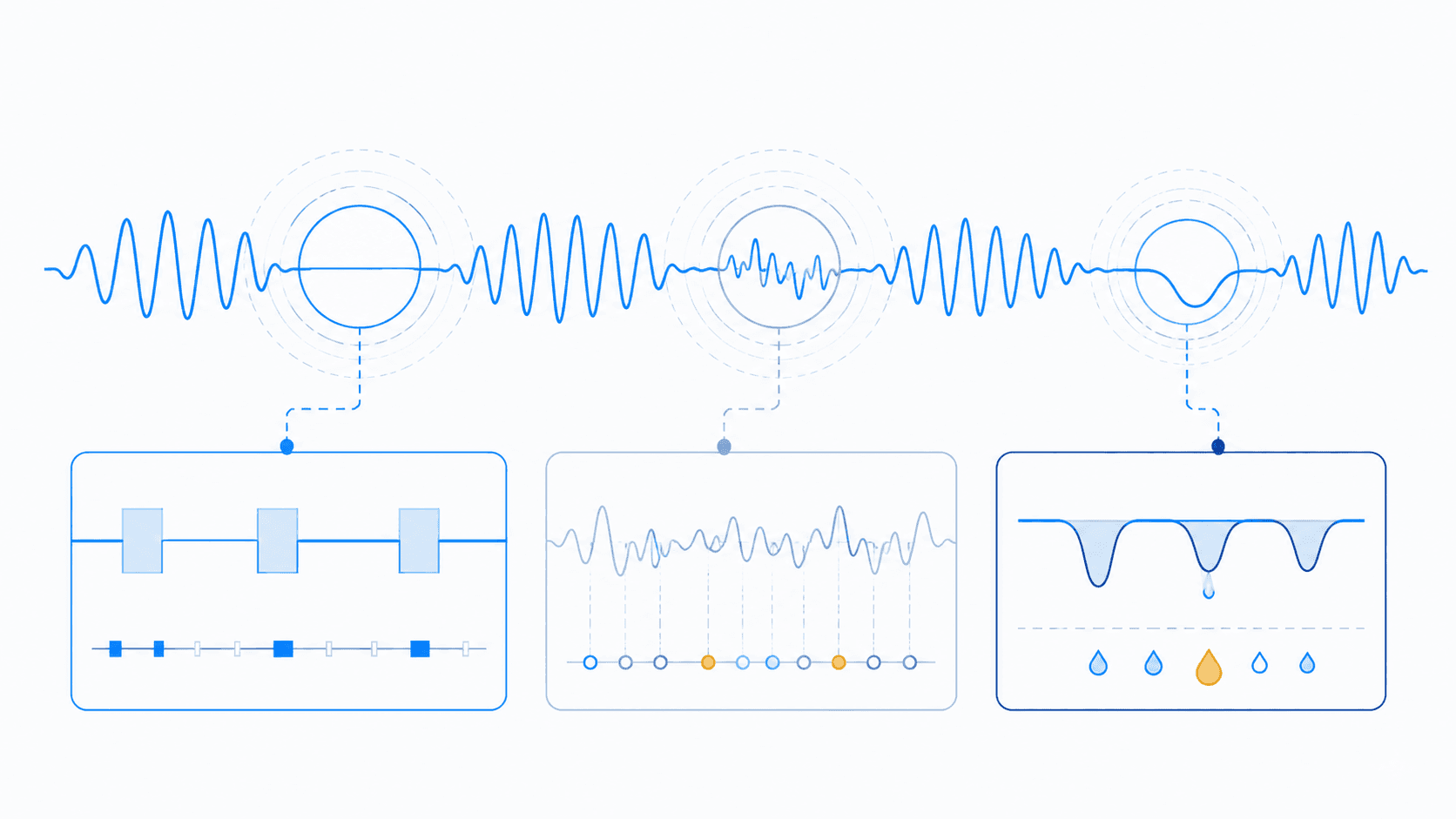
If you have read your sleep study report, you have probably noticed something confusing. Three different indices describe your breathing, and they do not always agree. Your AHI might be 12, which is mild. Your RDI might be 19, which falls into moderate territory by the same tiers. Your ODI might be 22, also moderate. Three numbers, two severity tiers, one patient.
The three indices measure related but distinct things. Their disagreement is not a bug in the report. It is often the most useful clinical information on the page, if you know how to read it.
Why the three indices can disagree
The indices look similar at first glance, since all three are some version of "events per hour." They are counting different things.
AHI counts respiratory events that meet specific thresholds. To count as a hypopnea, an event has to have at least a 30% airflow reduction for at least 10 seconds, and either a 3% oxygen drop or an EEG arousal (or, under the older Medicare-style scoring rule, a 4% oxygen drop with no arousal credit). Many real breathing disturbances do not quite meet these thresholds.
RDI adds RERAs to the AHI count. A RERA is a breathing-related arousal that fragments sleep without meeting hypopnea criteria. For example, increased breathing effort that wakes you up briefly but does not cause a measurable airflow drop or oxygen desaturation. RERAs are real disturbances. They just do not count under AHI.
ODI looks at oxygen specifically. It counts desaturations that meet a threshold (commonly 3% or 4% drops from baseline), regardless of whether each one was paired with an airflow event scored as a hypopnea. A patient who has many shallow breathing events that cause desaturations but do not quite meet hypopnea criteria will have a higher ODI than AHI. This pattern is common in people with reduced respiratory reserve, including those with COPD, obesity hypoventilation, or cardiovascular disease.
REI is the HSAT-specific cousin of AHI. The math is the same (events per hour), but the denominator changes. HSAT cannot directly measure sleep versus wake (no EEG), so it uses total recording time as the denominator instead of total sleep time. Since most patients are awake for at least some of the recording, REI typically under-calls the equivalent AHI by 10 to 30%. AASM acknowledges this in its scoring guidelines and recommends in-lab follow-up when HSAT results are borderline.
When each index is most informative
Different clinical questions surface different indices.
AHI is the diagnostic anchor. It is what insurance plans use to decide coverage. It is what guidelines reference for treatment thresholds. It is what most physicians cite when they tell you "you have moderate OSA." AASM defines OSA itself in part by AHI thresholds: AHI of 5 or more with at least one OSA-related symptom, or AHI of 15 or more regardless of symptoms. If you only look at one number, it is AHI.
RDI is the symptoms-vs-numbers reconciler. Some patients are obviously sleepy and unrefreshed but score borderline on AHI. RDI often explains the gap. RERAs are real sleep fragmentation events; the patient is being woken throughout the night by breathing effort, just not enough effort to trigger hypopnea criteria. If you are symptomatic with an AHI under 10, ask whether RERAs were scored and what your RDI is. The 2017 AASM clinical practice guideline allows RDI to substitute for AHI in diagnostic criteria when RERAs are scored.
ODI is the cardiovascular risk reader. Sustained oxygen desaturation correlates more directly with hypertension, atrial fibrillation, stroke risk, and metabolic dysfunction than AHI does. Two patients with identical AHIs can have meaningfully different cardiovascular risk profiles depending on their ODI and T90 (time spent below 90% saturation). If your AHI is mild but your ODI is high, your cardiovascular conversation is different than your respiratory one.
REI flags HSAT under-reporting. If your test was at home and your REI is 4.5, the equivalent PSG-derived AHI could plausibly be 6 or 7, across the diagnostic threshold for mild OSA. A borderline negative HSAT in a symptomatic patient should not close the door on OSA workup. Either an in-lab follow-up or, increasingly, a multi-night HSAT (which improves sensitivity over a single night) may be warranted. For a deeper look at when HSAT is appropriate versus when in-lab PSG is required, see Home Sleep Tests vs In-Lab Polysomnography.
Which index drives diagnosis and coverage
Diagnosis and insurance coverage both use AHI, but with a wrinkle.
The AASM 2017 OSA diagnostic criteria define OSA as either (a) AHI of 5 or more with at least one OSA-related symptom (excessive daytime sleepiness, fatigue, insomnia, snoring, witnessed apneas, choking awakenings, hypertension, mood disorder, cognitive dysfunction, coronary artery disease, stroke, congestive heart failure, atrial fibrillation, or type 2 diabetes) or (b) AHI of 15 or more regardless of symptoms. RDI can substitute for AHI in this framework when RERAs are scored.
But the AHI on which your insurance bases its coverage decision can differ from the AHI on which a clinician bases their diagnosis. Medicare uses the older 4% hypopnea rule (4% desaturation, no arousal credit), which produces a lower AHI than the AASM-recommended 3% rule (3% desaturation or arousal). Many private insurers follow Medicare's lead; some have moved to the 3% rule; coverage policies vary. The result is that the same patient, with the same study, can be "covered" by one insurer and "not covered" by another, depending on which scoring rule the coverage policy specifies.
This is why your report's methods section matters. If your AHI is borderline and you are denied coverage, finding out which rule was used in your scoring (and whether a rescore under the other rule would change the result) is worth doing before you accept the denial.
How clinicians integrate all the indices
In practice, clinicians do not look at one index in isolation. The decision conversation incorporates:
- Whole-night AHI for baseline severity
- RDI for symptoms-vs-AHI reconciliation when AHI is borderline
- Position-specific AHI (supine vs lateral) for positional therapy candidacy
- REM-specific AHI to identify REM-predominant OSA
- The obstructive vs central vs mixed event breakdown for treatment selection
- ODI and T90 for cardiovascular risk weighting
- Sleep architecture for fragmentation severity
- The patient's symptoms, comorbidities, age, weight, and treatment goals
A patient with AHI 12 (mild), ODI 22 (moderate territory by ODI tier conventions), and significant daytime sleepiness has a different clinical picture than a patient with AHI 12, ODI 6, and no symptoms. The numbers alone are inputs to clinical judgment, not substitutes for it.
What to do with this when reading your report
Look at all three indices, not just AHI. Make a quick mental note of whether they tell a consistent story or whether one is meaningfully higher than the others. If RDI is well above AHI and you have symptoms, you have an answer to why. If ODI is well above AHI, your cardiovascular conversation deserves attention separate from your respiratory one. If REI is borderline negative on an HSAT and you have classic OSA symptoms, do not assume you are in the clear.
Then go to the methods section of your report. Find out which hypopnea scoring rule was used (3% with arousal credit, or 4% without). If your AHI sits near a coverage threshold, this matters.
If you want a plain-English read on what your AHI specifically means and what AASM considers first-line treatment for that tier, you can use the AHI Interpreter.
The three indices together tell you more than any single one of them does. They are designed to complement each other. Treat your report as the multi-dimensional picture it is, not as a single severity number with two confusing footnotes.
Sources
This article is grounded in the primary clinical sources below, linked so you can verify the details yourself.
- AASM Manual for the Scoring of Sleep and Associated Events (Version 3, 2023)
The definitive reference for scoring apneas, hypopneas, RERAs, arousals, and the indices reported on a sleep study.
- Kapur et al. Clinical Practice Guideline for Diagnostic Testing for Adult OSA, AASM 2017
Source for the AASM framework for diagnosing OSA in adults and the role of home versus in-lab testing.
- AASM clarifies hypopnea scoring criteria: recommended 3% rule versus acceptable 4% rule
Why the scoring rule used changes the AHI and ODI a report shows.
- Medicare National Coverage Determination 240.4: CPAP Therapy for Obstructive Sleep Apnea
Source for Medicare's use of the 4% hypopnea rule in coverage decisions.
Related
AHI Interpreter
Enter your AHI to see severity tier, what it means, and treatment landscape.
Understanding Your Sleep Study Report
What every number on your sleep study report actually means, including the sections most patients miss.
Home Sleep Tests vs In-Lab Polysomnography
When a home sleep test is appropriate, when an in-lab study is required, and what each one actually measures.
Educational only, not medical advice. Information provided is for educational purposes and is not a substitute for professional medical advice, diagnosis, or treatment. Talk to your physician about your sleep test results.
First published: May 12, 2026 · Last modified: May 12, 2026